
The Nordic Edge – Why EU Inc Could Become Europe’s Fast Track to Innovation Sovereignty
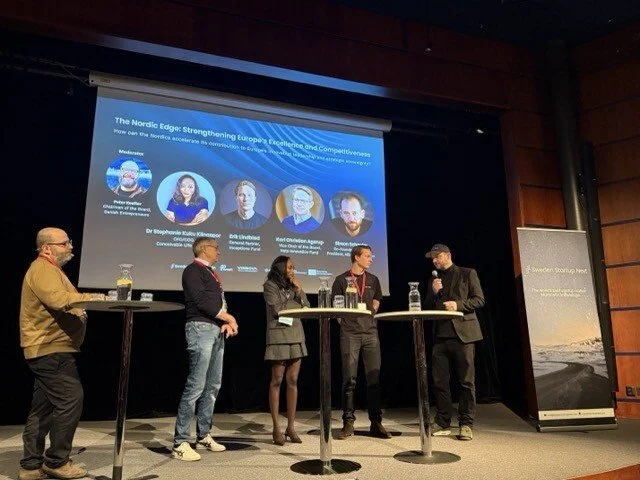
At the Next Innovation Policy Forum during GoWest in Gothenburg, one concept surfaced repeatedly as both a symbol and a solution to Europe’s innovation challenge: EU Inc.
In a panel bringing together leaders from venture capital, life sciences, defence innovation and startup policy, EU Inc — often referred to as the 28th regime — emerged as a concrete response to Europe’s most persistent problem: a fragmented market that forces globally ambitious startups to scale elsewhere.
Moderated by Peter Koefler (Danish Entrepreneurs), the discussion made clear that while Europe has world-class research, talent and technology, it is still missing the legal and institutional infrastructure needed for companies to grow fast, across borders, and at scale .
EU Inc: from policy idea to political momentum
EU Inc was originally conceived as a private-sector initiative, driven by founders and investors who repeatedly encountered the same barriers: 27 corporate law systems, incompatible stock option rules, slow company registration, and costly legal complexity for even the smallest cross-border step.
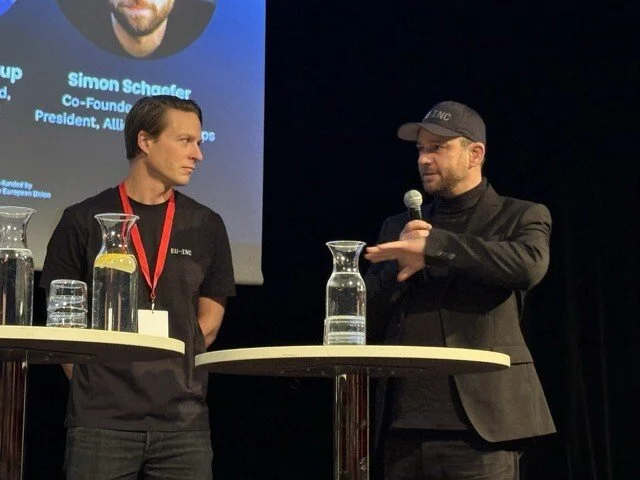
During the panel, Simon Schaefer, Founder of EU Inc and Chair of Allied for Startups, described why the initiative has gained unexpected traction — including adoption of the term by the European Commission itself.
“Our corporate law is from before the internet — and we are trying to regulate internet-native companies with it.”
EU Inc proposes a single, digital-first European company framework, allowing startups to incorporate, hire, issue stock options, raise capital and operate across borders under one consistent regime. It does not replace national systems, but exists alongside them — offering founders a European alternative to Delaware.
What made the discussion particularly relevant for a Nordic audience was the growing recognition that smaller, digitally mature countries may be best positioned to move first.
The Nordic advantage as a launchpad
Several panelists argued that the Nordics already operate closer to the logic of EU Inc than most of Europe: high-trust societies, limited use of notaries, advanced digital public services, and close collaboration between regulators and innovators.
For Erik Lindblad, General Partner at Inception Fund, the case is not theoretical. Despite backing Nordic-founded deep tech startups, he sees many incorporate in the US from day one.
“It’s not the entrepreneur’s job to be a political advocate. It’s their job to do what’s best for the company — and right now, that often means incorporating in the US.”
From his perspective, EU Inc is less about European idealism and more about keeping value creation in Europe. Without a unified framework for company formation, employee incentives and cross-border hiring, Europe risks training companies that scale — but not at home.
If EU-wide agreement proves too slow, several speakers suggested a Nordic–Baltic pilot, fully aligned with EU Inc principles and open for others to join over time — creating momentum through action rather than consensus.
Scaling trust: EU Inc and strategic technologies
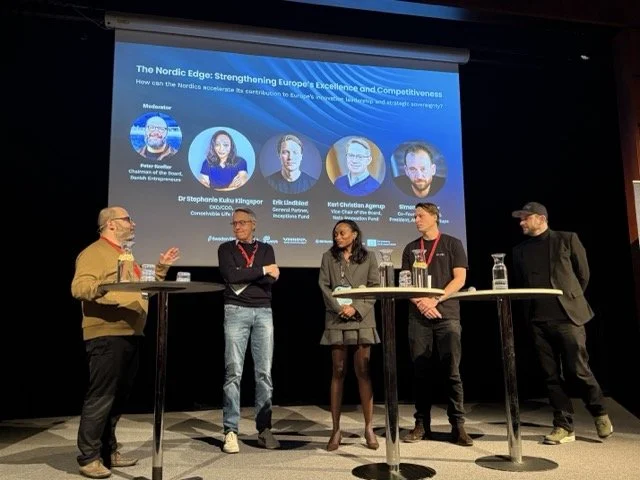
The relevance of EU Inc extends beyond startups in software or fintech. Dr. Stephanie Kuku, Chief Knowledge Officer at Conceivable Life Sciences, highlighted how fragmented regulation is particularly damaging in health, biotech and AI — sectors that require scale, data access and long-term investment.
“You can’t have strategic sovereignty if you can’t produce your own vaccines, biologics and diagnostics — at scale.”
She argued that the Nordics already have a critical edge: trusted public institutions, high-quality population data, and regulators who actively collaborate with innovators. EU Inc, in this context, could provide the missing structural layer that allows platform biology and AI-driven health solutions to scale across Europe, rather than remaining confined to national pilots.
Defence, deep tech and the urgency to act
From a defence and security perspective, Karl Christian Agerup, Vice Chair of the NATO Innovation Fund, framed EU Inc within a much sharper timeline.
“Urgency has changed dramatically. This is no longer just about competitiveness — it’s about defence.”
With war on Europe’s eastern border and rapid advances in AI, robotics and dual-use technologies, he argued that speed of adoption and scale of deployment are now strategic assets. The Nordics already function as a single defence innovation market — and EU Inc could apply the same logic to Europe’s civilian innovation economy.
Yet Agerup also warned that regulation alone will not solve Europe’s deeper problem: value creation. Without stronger capital markets, better exit opportunities and pension capital flowing into innovation, even a perfect company framework will fall short.
From concept to execution
By the end of the panel, EU Inc stood out not as a silver bullet — but as a credible starting point. A way to fix the earliest and most painful friction points in the startup journey, while unlocking broader reforms in capital markets, talent mobility and industrial policy.
The Nordics cannot solve Europe’s innovation gap alone. But as several panelists concluded, they may be uniquely positioned to prove that EU Inc can work in practice — and in doing so, help Europe move from policy alignment to real execution.
