From Vision to Execution: What Europe Learned at Next Innovation Policy Forum
When Europe’s innovation community gathered in Gothenburg during GoWest - Nordic Venture Capital Forum on 28 January, the message was unmistakable: Europe has entered its execution decade.
At the Next Innovation Policy Forum, this shift was not only discussed – it was demonstrated. The day brought together policymakers, founders, investors and industry leaders around a shared challenge: turning ambition into action. It also marked a concrete milestone with the official launch of Sweden Startup Next, signaling a move from mapping innovation to enabling smarter, data-driven execution.
Across panels and perspectives, one insight stood out: Europe’s future competitiveness will not be shaped by new strategies – but by connected systems that actually work.
Alignment is Europe’s real advantage
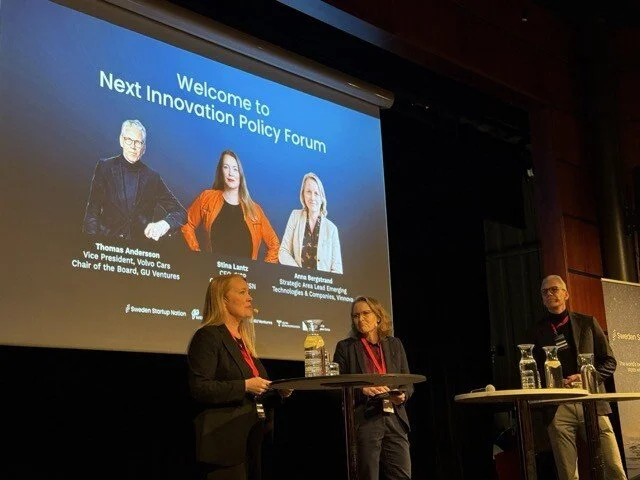
The forum opened with welcoming remarks from Anna Bergstrand (Vinnova), Stina Lantz (SISP – Swedish Incubators & Science Parks) and Thomas Andersson (Volvo Cars and GU Ventures). Together, they framed the day around a simple but demanding task: connecting Europe’s many strong innovation actors into systems that move in the same direction.
Innovation excellence already exists. The challenge lies in alignment – across regions, sectors and policy silos.
Nordic strengths, European relevance
The first panel explored how Nordic ecosystems can reinforce Europe’s competitiveness and technological sovereignty.
From a venture capital perspective, Erik Lindblad (Inception Fund) highlighted a reality many founders face daily: scaling across Europe remains harder than scaling to the US. That friction sat at the heart of Simon Schaefer’s ( EU–INC and Allied For Startups) inter intervention:
“Founders don’t leave Europe because they want to – they leave because scaling here is too complex. The 28th regime is about removing friction, not adding another layer.”
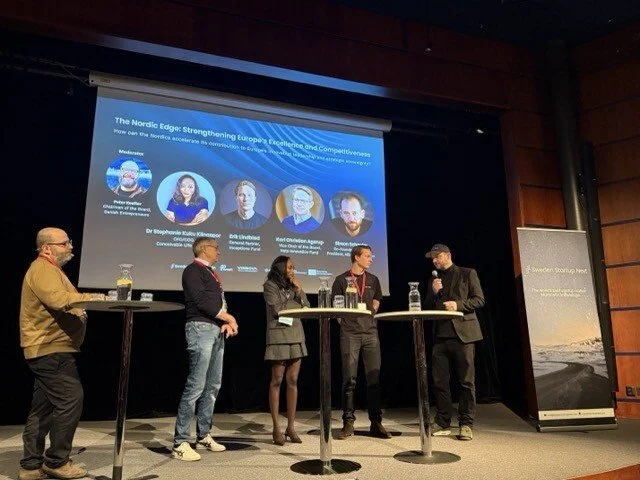
From defence and security, Karl-Christian Agerup (NATO Innovation Fund (NIF)) stressed that innovation speed is no longer just about competitiveness – but resilience. And from life sciences, Dr Stephanie Kuku, MD (Conceivable Life Sciences) pointed out that fragmented regulation makes it nearly impossible to scale health, AI and deeptech in parallel.
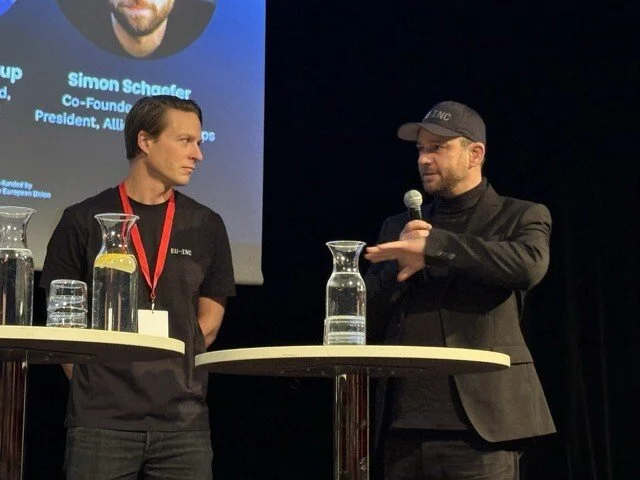
The panel converged on a clear conclusion: with high trust and digital maturity, the Nordics are uniquely positioned to act as Europe’s testbed for execution.
Choosing priorities — and sticking to them
In a keynote that deliberately slowed the tempo, Michiel Scheffer 🟥, President of the EIC - European Innovation Council, challenged Europe’s instinct to try to lead in everything at once.
“Every political priority comes with trade-offs. If Europe tries to lead in everything, it weakens its ability to execute.”
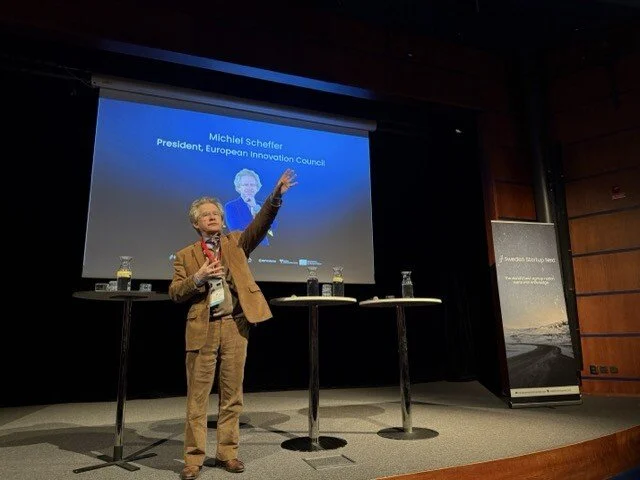
Michiel Scheffer 🟥, President of the EIC - European Innovation Council
Innovation, he argued, only matters when it reaches factories, workers and markets – and when entrepreneurs can trust systems to remain reliable over time.
That message echoed another key insight:
“Europe does not suffer from a lack of ideas. What we lack are systems we can trust – and scale.”
Capital: the missing middle
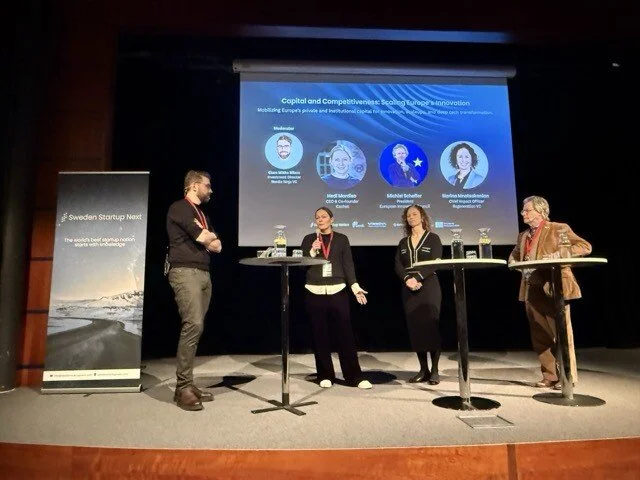
That focus on execution continued in the panel on growth capital, moderated by Claes Mikko Nilsen (NordicNinja VC).
In a recorded address, Jean-David Malo (European Commission) highlighted Europe’s paradox: world-class innovation, but too few global champions. Scheffer returned to outline how the upcoming Scaleup Europe Fund aims to crowd in private capital rather than replace it – addressing the critical gap between early success and late-stage scale.
From an operator’s perspective, Hedi Mardisoo (Cachet) pointed to Estonia as proof that speed, trust and simplicity attract both founders and investors. Narina Mnatsakanian (Regeneration.VC) reinforced the point: fragmentation still makes the US a more straightforward scaling market than Europe.
Green transition: execution over ideology
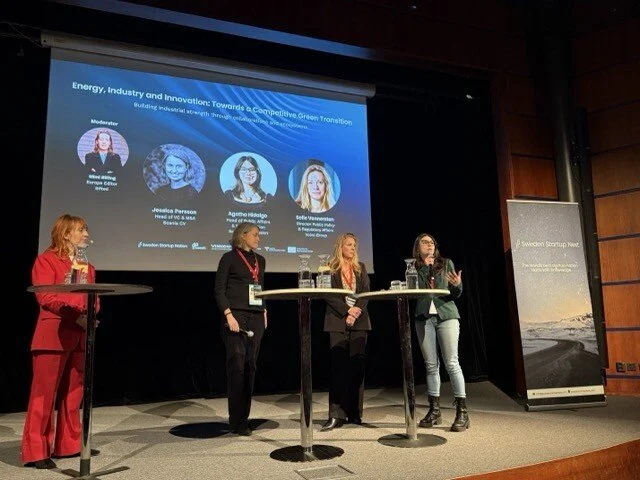
In the industry and energy panel, moderated by Mimi Billing (Sifted), the conversation turned to competitiveness in practice.
Jessica Persson (Scania Group) emphasised that Europe already has much of the technology it needs – but must execute faster and collaborate more deeply.
“Trust is the real accelerator. Without collaboration across value chains, the green transition will stall.”
Sofie Vennersten (Volvo Group) reinforced that decarbonisation and competitiveness are not opposites, while Agata C. Hidalgo (Renaissance Fusion) framed the green transition as geopolitics rather than ideology: delays and diluted ambition send powerful signals to markets and investors.
A defining moment: launching Sweden Startup Next
One of the forum’s defining moments came with a fireside chat marking the transition from Sweden Startup Nation to Sweden Startup Next.
Sasan Shaba (SISP) and Lisa Ericsson (KTH Innovation) explained why the shift matters. Sweden has long been an innovation leader – but without a shared, reliable data foundation, decisions have too often been driven by assumptions rather than evidence.
“Data changes behaviour. Without a common picture of the ecosystem, we end up debating opinions instead of making decisions.”
Sweden Startup Next represents a move from describing the ecosystem to actively enabling smarter, data-driven decisions for startups, investors and policymakers – turning insight into action.
Data as the backbone of execution
That theme carried into the final panel on data and ecosystems.
Kati Pärn (Startup Estonia) demonstrated how long-term, consistent data collection enables faster and more confident policymaking. Marije Dijksma (Techleap) highlighted data as a tool for accountability – when decision-makers remain engaged. Joonas Leppänen, PhD (Nordic Innovation) concluded that the challenge is no longer access to data, but coordination across borders.
Data, the panel agreed, is not a reporting exercise. It is infrastructure for execution.
The shared conclusion
In closing remarks, Lisa Ericsson and Stina Lantz returned to the forum’s central insight:
Europe does not need more strategies. It needs connected systems that execute.
And with the launch of Sweden Startup Next, that next step has already begun.