
Reliability Over Urgency: Europe’s Innovation Choices in a Time of Pressure
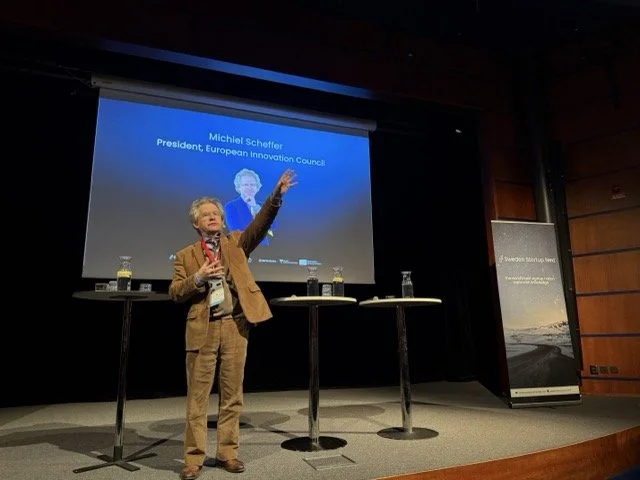
During Next Innovation Policy Forum at GoWest in Gothenburg earlier this year, a keynote by Michiel Scheffer, President of the European Innovation Council (EIC), offered a sobering counterpoint to calls for ever-greater speed in European innovation policy.
Positioned between the forum’s first and second panels, Scheffer’s address focused less on new initiatives — and more on the trade-offs, priorities and reliability required if Europe is to translate innovation into long-term competitiveness.
Urgency comes with a cost
Scheffer began by challenging one of the most common assumptions in today’s policy debate: that speed is always the right answer.
“Every urgency, every priority also means that you slow down and do less of something else.”
In a political system built on compromise, he argued, prioritisation inevitably means exclusion. More investment in defence may mean less in biotech; more focus on energy transition may reduce attention elsewhere. The real responsibility of politics, he stressed, is not to promise everything — but to accept the downsides of choice.
This perspective shaped much of the keynote: Europe does not suffer from a lack of ideas, but from the difficulty of aligning diverse disciplines, institutions and national interests into a coherent direction.
From innovation to industrial reality
A recurring theme was the gap between innovation and impact. For Scheffer, innovation only matters if it reaches factories, shops and everyday life.
“Innovation only matters if blue-collar workers can make it — and if you can buy it in a store.”
Europe, he argued, still holds a major structural advantage over the US: industrial depth. With around 30 million people employed in manufacturing, Europe retains practical know-how that many other regions have lost.
“We still know how to make things. That’s something the Americans often come to Europe for.”
But this advantage also creates constraints. With low unemployment across much of Europe, Scheffer warned that the continent cannot invest everywhere at once. Strategic focus is unavoidable.
Why startups matter — even when incumbents dominate
Scheffer also addressed a tension raised repeatedly during the forum: why the EIC continues to focus so strongly on startups.
“You have to give us new companies — because the old ones don’t deliver.”
While Europe’s large corporations remain critical to industrial strength, he described how short-term shareholder pressure, internal complexity and slow decision-making often limit their capacity for radical innovation. Startups, by contrast, challenge existing economic structures and inject long-term dynamism — even if many fail.
Capital, scale and the single market
Access to growth capital remains one of Europe’s most persistent bottlenecks. Scheffer referred to the recent launch of the Scaleup Europe Fund in Davos as a necessary step to mobilise larger pools of capital into the innovation system.
He also highlighted a significant — and for many unexpected — policy signal: the proposal to introduce the so-called “28th regime” as a regulation rather than a directive.
“With a directive, you still have 27 regimes. With a regulation, you have one.”
For Scheffer, this distinction matters deeply. A unified regulatory framework is essential if startups and scaleups are to operate across borders without friction — and if Europe is serious about building a genuine single market for innovation.
Reliability as Europe’s hidden strength
Perhaps the keynote’s most distinctive message was a defence of reliability over speed. While other systems may move faster, they also change rules frequently — often to the advantage of large incumbents with the resources to adapt.
“For entrepreneurs, you need a reliable system — where you know the rules will still be there next year.”
European research and innovation frameworks, Scheffer argued, may be slow to evolve — but they offer predictability. That stability, in a volatile global context, can be a competitive advantage if combined with sharper priorities.
Regions, rivalry and collaboration
Closing on a Nordic note, Scheffer observed how regional dynamics shape innovation outcomes. Unlike highly centralised ecosystems, the Nordics and countries like the Netherlands benefit from multiple innovation centres and healthy internal competition.
“Wanting to be better than the neighbouring city is always a powerful driver.”
For Scheffer, stronger regional integration, combined with friendly rivalry, may be one of Europe’s most effective — and underappreciated — innovation engines.
Choosing Europe’s future
Scheffer’s keynote did not promise easy solutions. Instead, it framed Europe’s innovation challenge as a matter of design, discipline and decision-making.
At Next Innovation Policy Forum, his message was clear: Europe does not need more urgency slogans. It needs clear priorities, reliable systems, and the courage to choose.
