
Energy, Industry and Innovation: Can Europe Compete in the Green Transition?
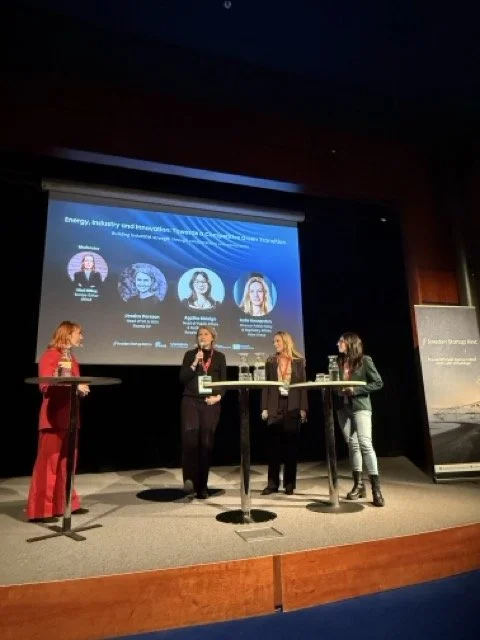
On 28 January, discussions at Next Innovation Policy Forum during GoWest in Gothenburg moved from capital and company scaling to a more fundamental question: can Europe deliver a competitive green transition while maintaining industrial strength and energy security?
In a panel, moderated by Mimi Billing, Europe Editor at Sifted, focused on energy, industry and innovation, leaders from heavy industry, frontier energy startups and European policy explored how governance, market instruments and industrial collaboration must align to accelerate decarbonisation — without undermining Europe’s global competitiveness.
Moderated from a European policy perspective, the discussion brought together Jessica Persson (Head of VC & M&A, Scania CV), Sofie Vennersten (Director Public Policy & Regulatory Affairs, Volvo Group) and Agata Hidalgo (Head of Public Affairs and Media Relations, Renaissance Fusion), offering a rare combination of industrial realism, startup urgency and EU-level insight.
Trust, urgency and Europe’s industrial backbone
From an industrial standpoint, Jessica Persson struck a cautiously optimistic tone. Having worked across Asia and Europe, she emphasised that Europe’s greatest current asset is not technology alone — but trust and collaboration across sectors.
“Trust is the foundation for everything — it allows us to shortcut administration and execute faster. The technology is already there.”
At the same time, she warned that Europe’s risk-averse culture and tendency to over-administrate could slow execution at a moment when speed and scale matter more than perfection. For heavy transport and green industry, the challenge is no longer invention, but industrialisation.
Energy innovation as geopolitics, not ideology
For Agata Hidalgo, the green transition cannot be separated from geopolitics, energy autonomy and long-term industrial jobs. While acknowledging political uncertainty — particularly in the US — she argued that global momentum for energy innovation remains strong.
“The green transition is not dead just because one administration is not prioritising it.”
She pointed to energy innovation as one of the world’s most funded sectors in 2025, with fusion and next-generation energy technologies attracting growing private capital. For Hidalgo, the key risk is not lack of ambition, but Europe’s slowness in turning political signals into concrete action.
“We need to show political leadership fast — delays and diluted ambition send the wrong signal to the market.”
Competitiveness and decarbonisation must move together
From a systems and policy perspective, Sofie Vennersten highlighted Europe’s strong industrial base — and the danger of treating climate ambition and competitiveness as opposing goals.
“It’s not enough to innovate. If we cannot industrialise, we won’t create jobs, tax revenues or long-term resilience.”
She stressed that Europe’s challenge is systemic: all parts of the equation must move in parallel. For heavy transport, that means technology, energy supply, infrastructure, regulation and demand-side incentives advancing together — otherwise the transition stalls.
The infrastructure gap: where ambition meets reality
One of the most concrete bottlenecks discussed was charging infrastructure for heavy electric trucks. Europe has ambitious targets — but a significant gap between policy and physical reality.
To meet climate goals, around 50,000 charging stations for heavy trucks will be needed across Europe by 2030. Today, there are roughly 2,000.
“If one part of the system is zero, the whole transition becomes zero.”
The panel agreed that infrastructure, vehicle deployment and demand creation must be coordinated corridor by corridor, milestone by milestone — supported by public procurement, regulatory incentives and shared risk-taking.
Industry–startup collaboration as a scaling engine
A recurring theme was the underused potential of Europe’s large industrial players as scale-up partners. Persson argued that companies like Scania, Volvo and others bring decades of experience in global industrialisation — a capability many startups lack.
“If you can deliver to heavy industry — 24/7, for ten years, in extreme conditions — you can scale almost anywhere.”
Rather than seeing collaboration with incumbents as distortionary, the panel framed it as a shortcut to global markets, provided competition rules allow for pragmatic cooperation.
State aid, fragmentation and the missing EU industrial policy
The discussion also touched on divergent national approaches to state aid. While countries like France and Germany actively support strategic industries, others remain more restrictive. According to Hidalgo, this is a symptom of a deeper issue.
“If we had a real EU industrial policy at scale, there would be less need for national state aid.”
Until then, she argued, targeted public support may be necessary — because inaction is the worst option of all.
From ambition to execution
As the panel concluded, there was broad agreement on one point: Europe does not lack vision, technology or industrial heritage. What it lacks is coordinated execution at speed.
The green transition will only be competitive if energy innovation, industrial scale-up and regulatory frameworks move together — and if Europe is willing to back its priorities with both capital and confidence.
At Next Innovation Policy Forum, the message was clear: the green transition is not a trade-off against competitiveness — it is one of its defining tests.
